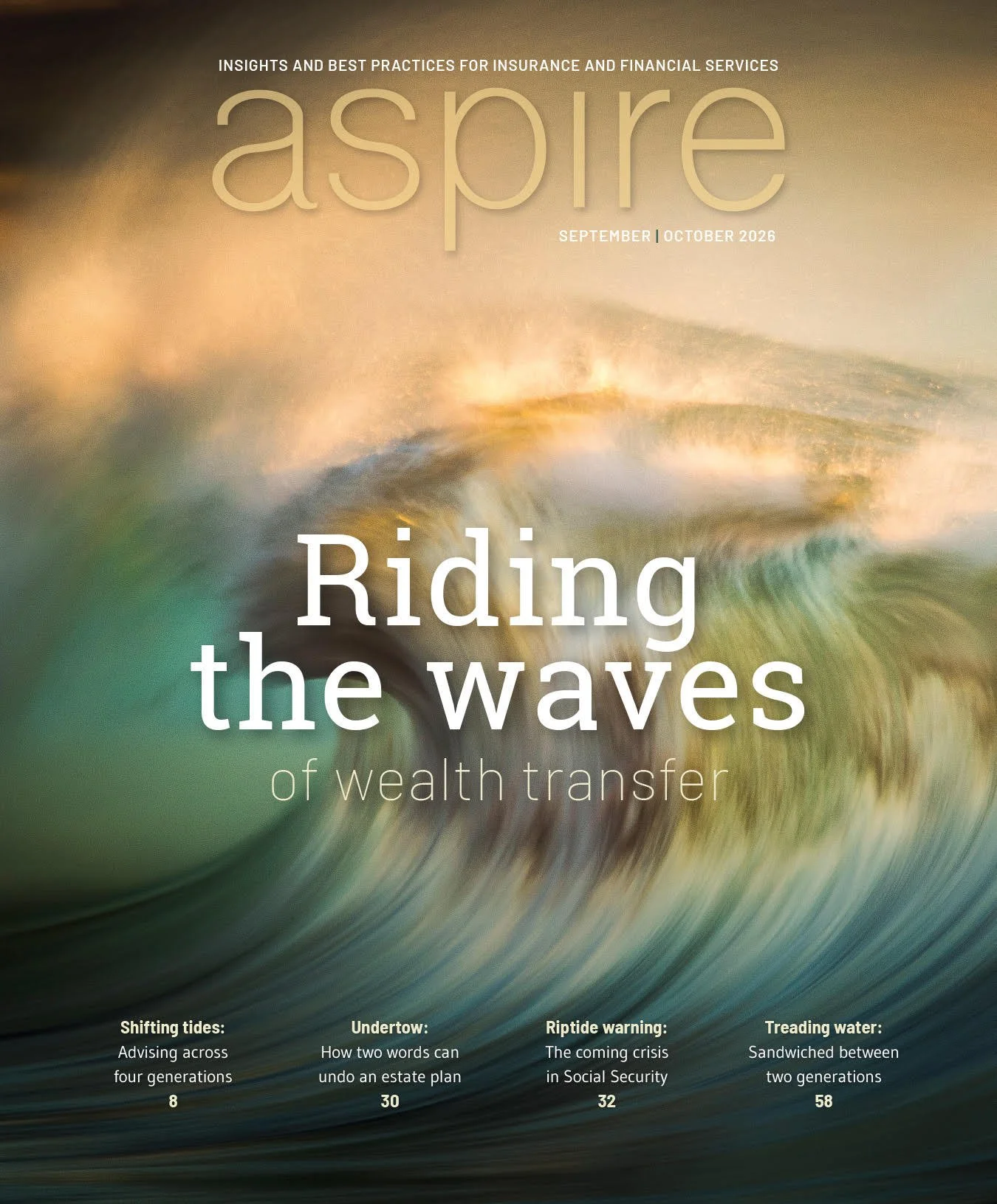
September-October 2026
Featured Articles
-
By the time an estate is settled, more than 70% of non-spouse heirs plan to fire their parents’ financial advisor. This is not a new stat; it has held steady for over a decade. What’s new is the scale of wealth it applies to. Continue reading…
-
Every BGA and IMO talks about strategy — fewer talk about what actually makes strategy work: culture. The strongest plans succeed because the people executing them trust each other, communicate openly, and share a common set of values. Culture drives behavior, and behavior drives execution. Continue reading...
-
What keeps each generation up at night? While every generation shares the same ultimate goal — building a secure financial future — the path to getting there varies greatly depending on where someone is in life. Continue reading…
-
In recent years, more top college football players have made the difficult decision to skip bowl games and other marquee matchups not because they’ve lost the competitive fire, but because they’re protecting something even more valuable than a championship: their financial future. Continue reading…
-
When clients talk about estate planning, the conversation usually centers on wills and trusts. While those documents are important, they don’t always control how assets are distributed at death. That’s a critical point for clients to understand — because some of a client’s most valuable assets may bypass their estate plan entirely. Continue reading...
-
Since its inception 90 years ago, it has been broadly assumed that Social Security benefits would continue to be paid in full, adjusted for inflation, for the lifetime of every retiree. That assumption is no longer safe. If Congress does nothing, benefits will be automatically reduced to roughly 77% of scheduled levels. Continue reading...
-
Life insurance and disability insurance can play critical roles in funding buy-sell agreements when a triggering event occurs. Without adequate funding, even the most carefully drafted agreement can fail, leaving owners and their families in financially and emotionally difficult situations. Continue reading...
Recent Issues